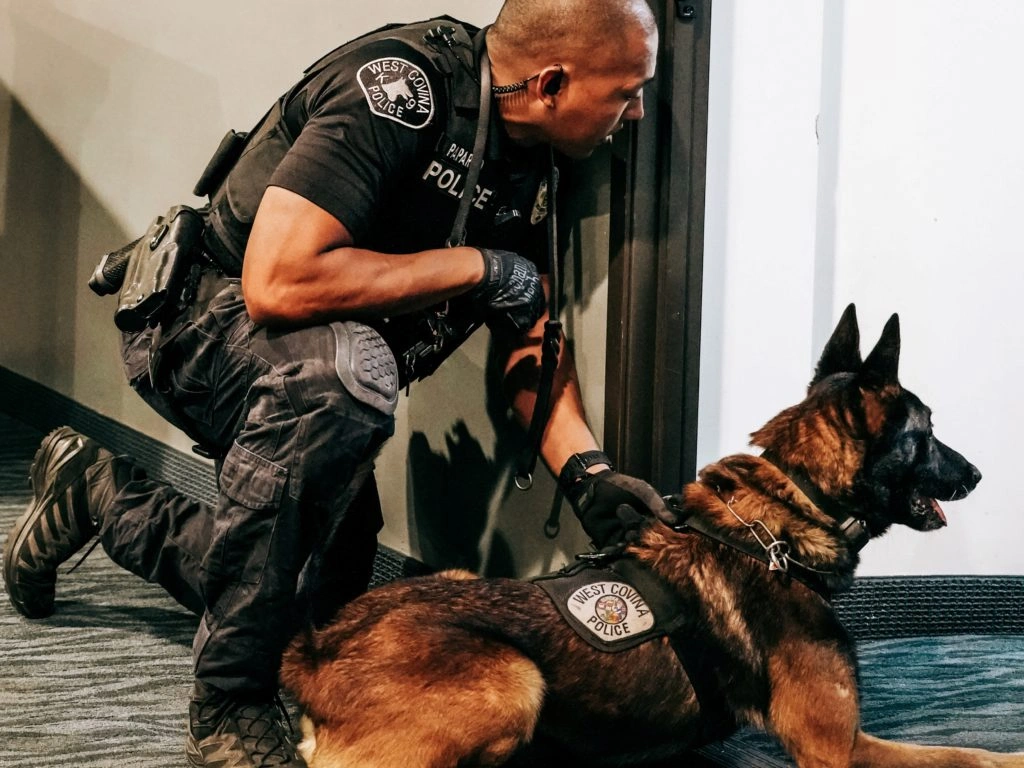
The Origin of K-9 Units: From Medieval Times to Modern Day | The bond between humans and dogs spans thousands of years, but their transformation from simple guardians into official components of modern law enforcement is a story of remarkable intelligence, loyalty, and adaptation. Today, we frequently see these formidable dogs wearing specialized vests as they stride through airports, sweep secure areas, or help officers manage large demonstrations. Known globally as K-9 units (a phonemic play on the word canine), these extraordinary animals are far more than pets; they are dedicated law enforcement personnel with official ranks, legal protections, and duties that often put their lives on the line.
How did their involvement in the world of crime prevention begin? Which breeds lead the front lines today? And why remains their role irreplaceable by even the most advanced technology? Let us dive deep into the long journey of these four-legged officers in keeping global communities safe.
From the Middle Ages to the Streets of London: A Historical Retrospective
Tracing back the timeline of using dogs to hunt down criminals reveals that this practice is by no means a modern phenomenon. Its roots extend deep into the Middle Ages in Europe.
Pursuing Outlaws in Scotland and France
In the early days, villagers often pooled their wealth to pay for the upkeep of the parish constable’s bloodhounds. These dogs were used specifically to track down outlaws and fugitives who fled into dense forests or remote terrains.
The earliest official record of dogs being utilized by law enforcement authorities dates back to the early 14th century in St. Malo, France. In this bustling port city, guard dogs were unleashed at night to secure the docks and piers from nighttime plunderers.
Meanwhile, by the late 14th century, Scotland began utilizing a strain of bloodhounds they referred to as “Slough dogs.” This very term eventually gave birth to the English word “sleuth” (meaning detective or investigator), which we still use today. For centuries afterward, the primary focus of police dogs across the British Isles and the European continent remained the same: harnessing their keen sense of smell to track human footprints.
Urbanization and a Notorious Failure in the Era of Jack the Ripper
As the 19th century brought massive waves of urbanization to England and France, crime rates skyrocketed. Conventional law enforcement in London, known at the time as the Bow Street Runners, struggled to contain the chaos on their own. Consequently, private citizen associations began hiring night watchmen who were equipped with firearms and dogs to protect their properties.
Despite the urgent need for tracking dogs, integrating them into official police institutions was not a seamless process. One of the most famous—and embarrassing—experiments occurred in 1889. Sir Charles Warren, the Commissioner of the London Metropolitan Police at the time, faced immense pressure and vilification from the press for his failure to identify and apprehend the legendary serial killer, Jack the Ripper.
In response to the fierce criticism, Warren attempted to train two bloodhounds to track the killer from the scene of one of the crimes. Unfortunately, the test ended in disaster. Instead of uncovering clues, one of the hounds bit the Police Commissioner, and both dogs subsequently ran off, forcing the London police to launch a separate search operation just to find them.
Continental Europe and the Birth of Modern K-9 Policing
The failure in London did not halt innovation elsewhere. In fact, it was in Continental Europe that the concept of using dogs for policing was developed scientifically and organizationally for the first time.
Pioneers from Belgium and Germany
The city of Ghent in Belgium goes down in history as the pioneer that launched the world’s first organized police dog service program in 1899. This innovative step quickly caught the attention of neighboring countries, including Austria-Hungary and Germany.
Germany then took this methodology to a much higher level through a rigorous scientific approach. They began serious experiments in dog breeding and training methodologies. In 1920, the German police opened the very first specialized dog training school in Greenheide.
It was here that the German Shepherd was selected as the ideal breed for police work due to its combination of obedience, strength, and intelligence. These dogs were systematically trained to obey handler commands, track scents, and neutralize criminals trying to escape or attack.
Developments in Britain and Global Adoption
Witnessing the success in Continental Europe, Britain began catching up. In 1908, the North Eastern Railway Police started using police dogs to put an end to theft at the Hull docks. Two years later, in October 1910, the City of Nottingham became the first territorial police force in the UK to officially purchase and operate a specially-trained police dog to assist officers on night patrols. From that point forward, the use of K-9s spread globally, becoming a mandatory standard for modern law enforcement.
Elite Breeds at the Front Lines of Law Enforcement
Not all dogs possess the mental and physical qualifications required to become a K-9. The modern law enforcement industry is highly selective, typically relying on a few specific breeds that display exceptional work characteristics:
-
German Shepherd: Historically, this breed is the ultimate icon associated with the image of a police dog. They are highly intelligent, loyal, easily trained, and possess an intimidating physical stature that deters criminal behavior.
-
Belgian Malinois: In recent years, this breed has overtaken the German Shepherd as the primary choice for various elite military and police units worldwide. Their slightly smaller frame makes them more agile, and they possess an incredibly high energy drive, intense focus, and superb physical endurance in extreme weather conditions.
-
Bloodhound: Blessed with the sharpest sense of smell in the animal kingdom. This breed is rarely used for physical apprehension; instead, they are the premier asset for missing person missions or tracking fugitives who have been on the run for days.
-
Dutch Shepherd: Similar to their Belgian and German relatives, these dogs are known for their remarkable focus, protective nature, and high efficiency in tactical operations.
-
Labrador Retriever: With their friendly and non-intimidating appearance, Labradors are the perfect choice for detecting narcotics and explosives in crowded public spaces like airports, transit stations, or high-profile diplomatic events.
Duties and Specializations of Modern K-9 Units
In the modern era, K-9 units are no longer restricted to chasing down street criminals. Their duties have been specialized into several crucial functions that help keep communities safe:
Narcotics and Explosives Detection
Utilizing millions of scent receptors in their noses, detection dogs can sniff out addictive substances or bomb components hidden deep inside concrete walls, fuel tanks, or even underneath thick layers of coffee grounds. Their ability to detect micro-molecules has yet to be fully matched by any man-made scanning technology.
Search and Rescue (SAR) Operations
When natural disasters such as earthquakes or landslides strike, K-9s become the greatest hope for locating victims trapped beneath rubble. They can distinguish the scent of living humans from the deceased at significant depths.
Protection and Suspect Apprehension
In high-risk tactical situations—such as hostage crises or arresting armed suspects—K-9s are deployed to neutralize targets without the immediate need to discharge lethal firearms. Their powerful bite and rapid acceleration can stop an escaping suspect in a matter of seconds.
The Emotional Bond and Legal Protection for K-9s
What makes a K-9 unit uniquely distinct from other law enforcement divisions is the profound relationship between the dog and its handler. Initial training typically lasts between eight months and a year. During this period, the dog and the handler learn to read each other’s body language, master verbal cues, and understand hand gestures.
This relationship does not end when the shift is over. In many countries, K-9 dogs live at home with their handlers, making them a true part of the family. This deep emotional bond is what transforms them into an extraordinary, cohesive team in the field.
Recognizing their sacrifices and status as valuable law enforcement assets, many nations have instituted strict legal protections for them. Intentionally injuring, abusing, or killing a police dog is treated as a felony charge equivalent to assaulting a human police officer, subjecting perpetrators to years in federal prison.
The extensive journey from simple dock guardians in 14th-century France to fully integrated tactical partners in the modern era highlights just how vital K-9 units are to human civilization. Amidst the rise of artificial intelligence and sophisticated electronic sensors, the loyalty, bravery, and natural instincts of a police dog remain completely irreplaceable. They are silent protectors, faithfully keeping our neighborhoods safe, one track at a time.