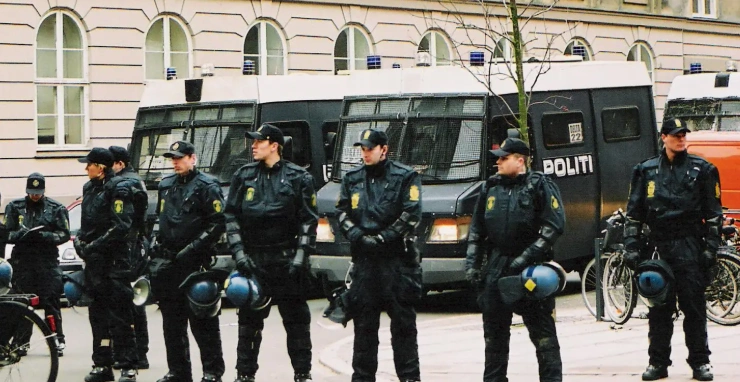
Inside Denmark’s Low-Corruption Police Culture | Denmark is widely known for its strong institutions, high level of social trust, and relatively low levels of corruption. These characteristics are also reflected in the country’s approach to policing.

For visitors and observers, Denmark’s police culture can appear noticeably different from the image of law enforcement found in many other countries. The relationship between police officers, citizens, and public institutions is shaped by professionalism, accountability, and a strong expectation of trust.
But what makes Denmark’s low-corruption police culture possible?
The answer is not simply strict laws or individual integrity. It is the result of institutional structures, social norms, professional standards, and a broader culture in which public officials are expected to serve the public interest.
What Does Low Corruption Mean in Denmark?
Low corruption does not mean that corruption or misconduct can never occur.
Instead, it describes an environment where bribery, abuse of public office, and improper influence are relatively uncommon and where institutions have mechanisms to identify and address misconduct.
Denmark consistently performs strongly in international assessments of public-sector integrity and corruption perceptions. Transparency International’s Corruption Perceptions Index has regularly placed Denmark among the countries perceived to have the lowest levels of public-sector corruption.
This broader institutional environment matters for policing because police officers operate within the same public-sector culture.
Trust as the Foundation of Danish Policing
One of the most important elements of Denmark’s police culture is public trust.
Police officers depend on cooperation from citizens. People are more likely to report crimes, provide information, follow lawful instructions, and cooperate with investigations when they believe law enforcement institutions are acting fairly.
Trust therefore becomes more than a positive social value. It can also be an important practical tool for effective policing.
When citizens expect police officers to behave professionally and impartially, officers are held to a high standard of conduct.
Professionalism and Public Responsibility
Danish police officers work within a professional framework that emphasizes responsibility and lawful conduct.
Police powers can significantly affect people’s lives. Officers may stop individuals, conduct investigations, make arrests, and use force in specific circumstances.
Because these powers are significant, accountability is essential.
A low-corruption police culture depends on the idea that authority should be exercised according to established rules rather than personal interests.
This distinction is important. A police officer should not be able to use official authority simply because of personal relationships, financial incentives, or social status.
Why Bribery Is Difficult to Normalize
Corruption often becomes easier to sustain when informal payments or personal favors are treated as normal parts of everyday life.
Denmark’s broader social environment makes this difficult to normalize.
Citizens generally expect public services to operate according to formal procedures rather than personal connections. Public officials are expected to make decisions based on their responsibilities, not on private benefits.
This does not eliminate every potential conflict of interest, but it creates a strong social barrier against treating corruption as an ordinary part of public administration.
Transparency and Accountability
Another important feature of Denmark’s institutional culture is the emphasis on transparency and accountability.
Police officers are not completely outside public scrutiny. Their actions can be subject to legal requirements, administrative procedures, complaints, investigations, and oversight.
Accountability is important because even highly trusted institutions can make mistakes.
A healthy police culture therefore does not depend on the assumption that every officer will always make the correct decision. Instead, it creates mechanisms for questioning decisions and addressing misconduct when necessary.
The Role of Danish Institutions
Denmark’s police culture cannot be separated from the country’s wider system of governance.
Strong institutions can reduce opportunities for corruption by creating clear procedures, professional standards, oversight mechanisms, and consequences for misconduct.
This creates an environment where an individual officer has fewer opportunities to turn public authority into private benefit.
In other words, integrity is supported not only by individual character but also by institutional design.
Social Equality and Police-Citizen Relations
Denmark’s relatively egalitarian social culture can also influence how citizens perceive public officials.
In highly hierarchical societies, citizens may feel that certain individuals or groups are entitled to special treatment.
A more egalitarian culture can create a different expectation: public officials are professionals carrying out public responsibilities rather than members of a privileged class.
This does not mean Denmark is completely free from social inequality or disputes about policing. It simply helps explain why the relationship between citizens and public institutions can be shaped by expectations of fairness and equal treatment.
Police Culture Is More Than Individual Integrity
It is tempting to explain low corruption by saying that Danish police officers are simply more honest.
That explanation is too simple.
Individual ethics certainly matter, but sustainable integrity usually depends on multiple layers working together.
These can include:
- Professional recruitment
- Training and ethical standards
- Clear legal procedures
- Internal supervision
- External oversight
- Transparent public institutions
- Accountability mechanisms
- Social expectations against bribery
- Public trust
When these factors reinforce each other, corruption becomes more difficult to normalize and more costly to conceal.
Can Denmark’s Model Be Replicated Elsewhere?
This is one of the most interesting questions surrounding Denmark’s experience.
Other countries can adopt anti-corruption measures, strengthen police oversight, improve professional training, and introduce greater transparency.
However, institutions do not operate in isolation.
A police reform program introduced into a country with weak public institutions, widespread political interference, or deeply established informal networks may produce different results from the same reform introduced in Denmark.
This means Denmark’s experience can provide useful lessons, but it should not necessarily be treated as a simple blueprint.
The Importance of Public Expectations
Police culture is shaped not only from inside police organizations but also by society.
When citizens expect officers to follow the law, reject inappropriate payments, explain their decisions, and treat people fairly, those expectations become part of the environment in which police work.
Public expectations can therefore reinforce institutional rules.
The relationship works in both directions: trustworthy institutions can encourage citizens to trust the police, while a culture of civic responsibility can encourage institutions to maintain high standards.
Challenges Still Exist
A low-corruption environment should never be confused with a perfect system.
Police institutions can still face challenges involving excessive use of force, discrimination, accountability, privacy, or individual misconduct.
Trust also creates an important responsibility. When people place significant confidence in an institution, violations of that trust can have serious consequences.
For that reason, maintaining a low-corruption police culture requires continuous attention rather than assuming that past success guarantees future integrity.
Lessons from Denmark
Denmark’s experience suggests that reducing corruption in policing is not simply about increasing punishment for corrupt officers.
A broader approach may be more effective.
Police officers need clear rules, professional incentives, meaningful oversight, and a workplace culture that treats integrity as part of the profession.
At the same time, citizens need accessible mechanisms for reporting concerns and seeking accountability.
Most importantly, public institutions need to demonstrate through their everyday actions that authority exists to serve the public rather than private interests.
Denmark’s low-corruption police culture is best understood as part of a wider institutional and social environment.
Strong public trust, professional standards, accountability, transparent governance, and social expectations around integrity all contribute to the way policing operates.
The Danish experience demonstrates an important lesson: corruption is not controlled by a single law or policy. It is influenced by the environment in which public officials work.
A police force is more likely to maintain integrity when its officers operate within institutions that reward professionalism, discourage abuse of power, and hold individuals accountable.
For Denmark, that combination has helped create a police culture in which public trust and institutional integrity remain central to the relationship between law enforcement and society.